
Learn what Skills Platform is, how built-in capabilities differ from Custom Skills, where CRM actions and external tools fit in, how Managed Agents use reusable instructions, and how to test and monitor agent activity before expanding access.
Skills Platform is not a separate product you install. Capabilities are configured through the AI Agent experience you are using. The exact tools, actions, permissions, and connectors available can differ by agent type, so only enable the capabilities required for that agent's role.
What is Skills Platform?
Skills Platform is the shared capability layer that allows AI Agents to perform tasks instead of only generating responses. A skill can represent a capability such as reading CRM information, updating a record, booking an appointment, searching approved knowledge, sending a message, starting an automation, or using an external tool.
These capabilities can be used across AI experiences such as Voice AI, Conversation AI, Agent Studio, and Managed Agents. The exact skills available depend on the agent type and the tools configured for that agent.
Skills Platform works behind the scenes. There is no separate installation process. Instead, you configure the actions, knowledge sources, reusable instructions, and connected tools available within the AI Agent experience you are building.
Key Benefits of Skills Platform
Skills Platform gives AI Agents reusable ways to perform work while helping administrators keep capabilities organized and appropriately scoped. This reduces duplicated configuration and makes it easier to understand what each agent is able to do.
- Shared Capabilities: Use common CRM, knowledge, communication, workflow, and external-tool capabilities across compatible AI Agent experiences.
- Granular Control: Limit an agent to the actions and tools appropriate for its role instead of giving every agent the same level of access.
- Reusable Configuration: Reuse supported capabilities and reusable instructions without rebuilding the same process inside every agent.
- Consistent Processes: Standardize how agents perform recurring tasks by combining built-in actions with clear instructions and Custom Skills where supported.
- External Connectivity: Extend supported agents with external applications or MCP-compatible tools when those connectors are available for the selected agent type.
- Better Visibility: Use agent testing, activity feeds, and execution details where available to verify which skills and tools were used during a run.
How Skills Work Across AI Agents
AI Agents, skills, tools, and reusable instructions serve different purposes. Keeping these concepts separate makes it easier to decide whether a task belongs in an agent's general instructions, a built-in action, a Custom Skill, a Knowledge Base, or an external connector.
| Concept | Purpose | Example |
|---|---|---|
| AI Agent | The configured agent responsible for handling a conversation, task, trigger, or process. | A Voice AI agent, Conversation AI bot, Flow Agent, or Managed Agent. |
| Built-In Skill or Action | Gives the agent an actual capability to perform work. | Send a message, update CRM data, search knowledge, or book an appointment. |
| Custom Skill | Stores reusable instructions describing how a Managed Agent should perform a repeatable task. | Lead qualification rules, meeting-summary format, or a standardized follow-up process. |
| Knowledge Base | Provides factual reference material the agent can retrieve when responding or completing tasks. | Policies, product information, FAQs, approved procedures, or reference documentation. |
| External Tool or Connector | Allows supported agents to interact with systems outside the platform. | An MCP connector or other supported external integration. |
Managed Agents: The experience previously referred to as Super Agents is now documented as Managed Agents in Agent Studio.
Skill Types and Capabilities
Skills can represent different kinds of work depending on the AI Agent you are configuring. The categories below are useful for planning an agent's responsibilities, but the exact actions available should always be confirmed in that agent's current configuration interface.
Use supported CRM actions to read, create, update, or organize information such as contacts, tags, fields, opportunities, and other records. Agent Studio's Actions Platform also supports common CRM-side operations such as sending messages, applying tags, creating custom data, and notifying users.
Depending on the agent and its channel, skills can support conversations, SMS, email, voice interactions, internal notifications, and follow-up activity.
Connect approved Knowledge Base sources so the agent can retrieve factual information when answering questions or completing tasks.
Agent Studio agents can respond to supported triggers and perform configured actions. Agents can also participate in larger workflow automations where supported.
Supported AI Agents can use external tools through integrations such as MCP connectors. Availability varies by agent type. Managed Agents can connect supported MCP apps in Agent Studio, and Voice AI can also be configured with MCP-compatible tools through its supported MCP integration.
Built-In Skills vs. Custom Skills
Built-in capabilities give an agent the ability to perform an operation, while Custom Skills tell a Managed Agent how your business wants a repeatable task performed. Understanding this difference prevents process instructions from being confused with the tools that actually execute an action.
| Type | What It Provides | Example |
|---|---|---|
| Built-In Capability | An operation the agent can execute. | Tag a contact, send SMS, update data, or search approved knowledge. |
| Custom Skill | Reusable instructions describing how a Managed Agent should perform a task. | Qualify leads using specific criteria or format meeting summaries consistently. |
Custom Skills for Managed Agents can contain:
- A skill name
- A description explaining when the skill should be used
- Detailed task instructions
- Qualification criteria or business rules
- Required output formats
- Restrictions or guardrails
- Conditions for escalation or another action
Per-agent control: A Custom Skill can be enabled or disabled for individual Managed Agents without deleting the skill from the shared skills library.
Permissions, Governance, and Monitoring
Agent capabilities should match the work the agent is responsible for. Limiting tools, actions, instructions, and connected systems reduces unnecessary access and makes testing and troubleshooting more predictable.
- Start with Minimum Access: Enable only the actions, skills, and external tools needed for the agent's current responsibility.
- Separate Facts from Processes: Store reference information in the Knowledge Base and reusable process instructions in Custom Skills where supported.
- Control External Tools: When configuring an MCP connector, select only the specific tools the agent should be able to use.
- Test Before Publishing: Use agent testing, sample conversations, or simulations to confirm the right capability is selected under the expected conditions.
- Review Execution Activity: For Managed Agents, use the Activity tab and execution logs to inspect completed steps, skills and tools used, inputs, outputs, timing, and run results.
Monitoring tip: If a Managed Agent behaves unexpectedly, open its Activity tab and review the affected run. The execution timeline can show which skill or tool was used and where an error occurred.
How To Configure Skills for AI Agents
Skills Platform does not require a separate installation. Configuration happens inside the AI Agent experience you are using by selecting the appropriate actions, knowledge, Custom Skills, and external tools, then testing the agent before production use.
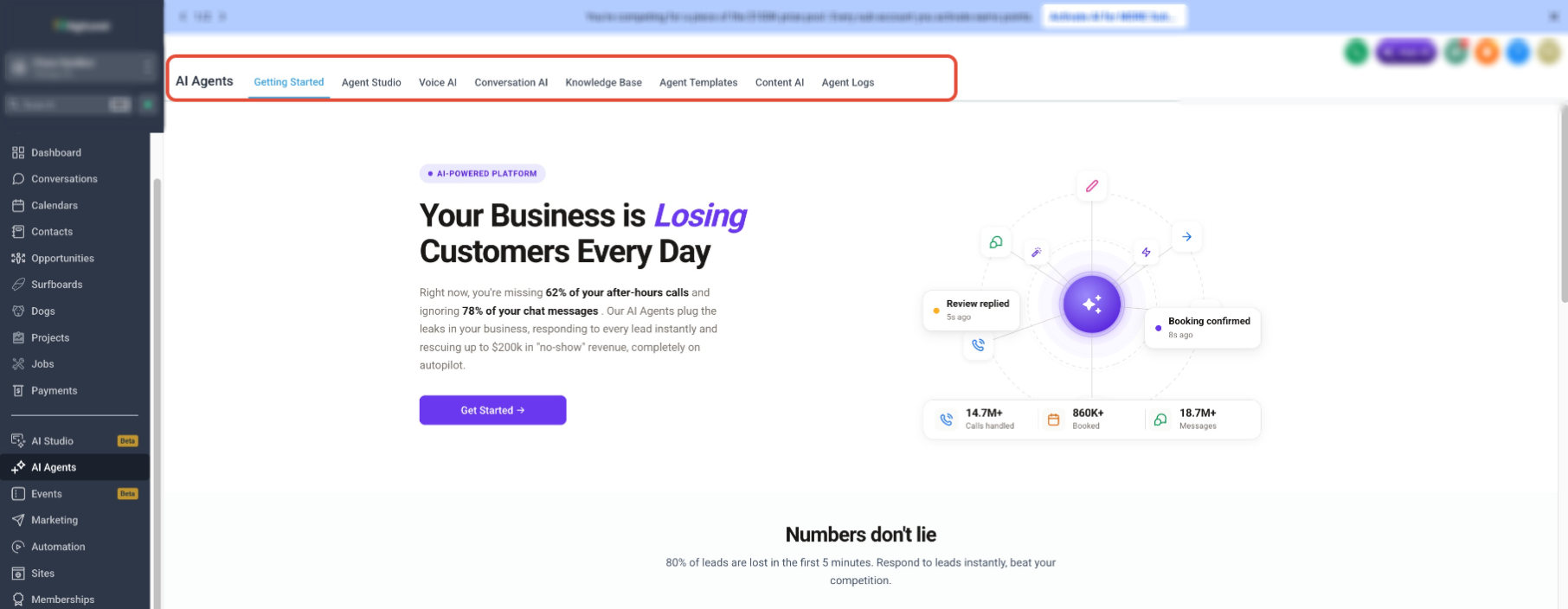
Open the AI Agent experience you want to configure. For Managed Agents, go to AI Agents → Agent Studio → Managed Agents. Other AI Agent experiences may expose their available tools and capabilities in different configuration areas.
Decide what the agent should accomplish and what it should not do. Use this responsibility to determine which CRM actions, communication tools, knowledge sources, Custom Skills, and external tools are actually necessary.
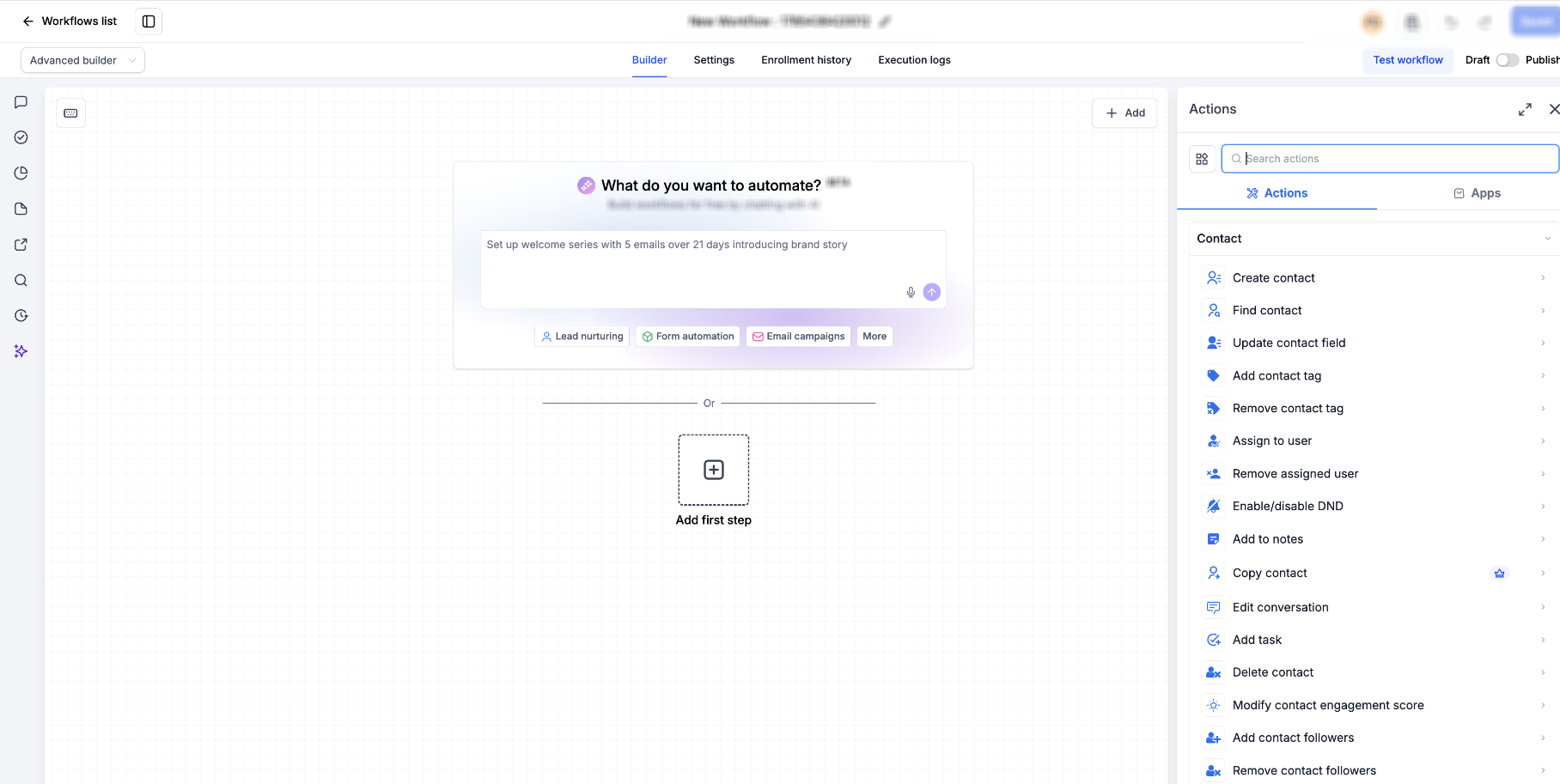
Add or enable only the actions the agent needs. In Agent Studio, supported CRM actions can include operations such as sending messages, applying tags, creating or updating CRM data, and sending internal notifications.
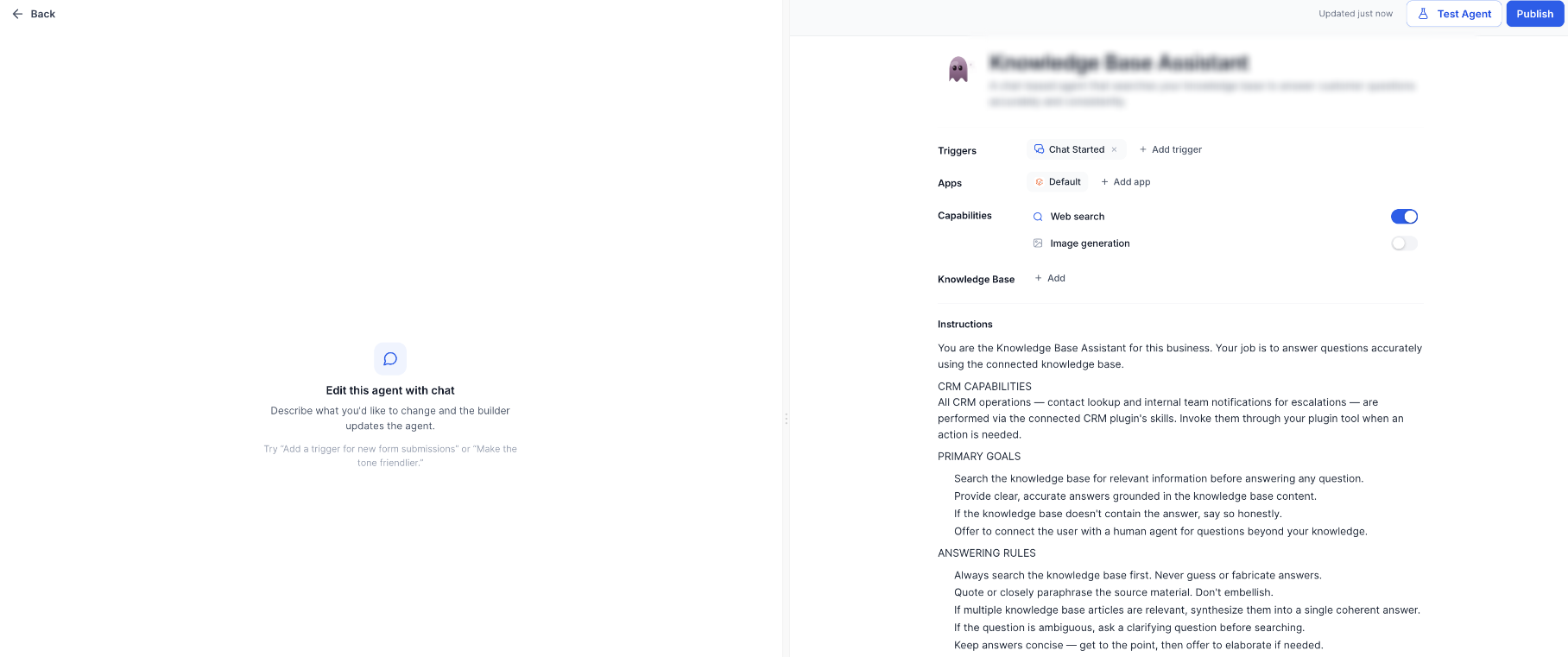
Connect the approved Knowledge Base sources the agent needs for factual answers. Keep process instructions separate when they are better represented as agent instructions or a Custom Skill.
For a Managed Agent, open Custom skills and use Manage skills when you need reusable, task-specific instructions.
- Click Add skill.
- Enter a clear skill name.
- Add a description explaining when the skill should be used.
- Enter the process, rules, format, or other instructions the agent should follow.
- Save the skill and enable it only for the Managed Agents that need it.
If the agent needs to work with an external system, add a supported connector or MCP integration from the agent experience where it is available. Authenticate the external account, then select only the specific tools the agent should be able to call.
Test realistic requests before production use. Confirm that the agent selects the intended skill or tool, receives the correct data, performs the expected action, and handles failure conditions appropriately.
For Managed Agents, review the Activity tab after testing or live runs. Open an execution to inspect completed steps, skills and tools used, inputs, outputs, timing, and the final result.
Frequently Asked Questions
Need Help?
- A capability is missing: Confirm that the action or tool is supported by the AI Agent type you are configuring and that your user has access to the required AI Agent feature.
- A Managed Agent does not use a Custom Skill: Confirm the skill is enabled for that agent and make the skill description specific enough for the agent to recognize when it applies.
- The wrong Custom Skill is selected: Make overlapping skill descriptions more distinct and narrow the instructions to a clearly defined process.
- Knowledge answers are incorrect: Verify that the intended Knowledge Base source is connected and contains the approved information the agent needs.
- An external tool fails: Check the connector authentication, confirm the required tool is enabled, and verify that the external service is available.
- An agent performs an unexpected action: Review its enabled tools, actions, instructions, and Custom Skills, then retest with narrower access.
- A Managed Agent run fails: Open the Activity tab and review the execution timeline to identify the failed skill, tool, input, or external call.
- Issue continues: Collect the agent name, agent type, affected skill or tool, run ID when available, relevant input, error message, and screenshots of the execution details before contacting support.