
Project Management brings tasks and projects directly into your CRM, so your team's work stays alongside the contacts and opportunities it relates to.
This introduction explains what Project Management is, how work is organized, and what each part does. It provides a foundation before you explore individual features in more detail.
TABLE OF CONTENTS
- What is Project Management?
- Where to Find Project Management
- Key Benefits of Using Project Management
- Use cases for Project Management
- How Work is Organized
- What a Task Contains
- Views: Kanban and List
- Steps for getting started
- Frequently Asked Questions
What is Project Management?
Project Management is a workspace for planning and tracking work. Instead of using a separate tool for your team's tasks and a CRM for customer information, you can create and manage tasks in the same platform where your CRM records live.
A task is a single unit of work with a status, an assignee, dates, and a priority. Tasks live inside Lists, Lists are organized into Spaces, and tasks can be broken down into subtasks.
Tasks can also be linked to CRM records, so related work remains visible in context. For example, instead of tracking a customer onboarding checklist in a spreadsheet and manually copying updates into the CRM, you can:
Create an onboarding List with a task for each step.
Assign each task to the responsible team member and set a due date.
Move tasks across the board as each step is completed.
Where to Find Project Management
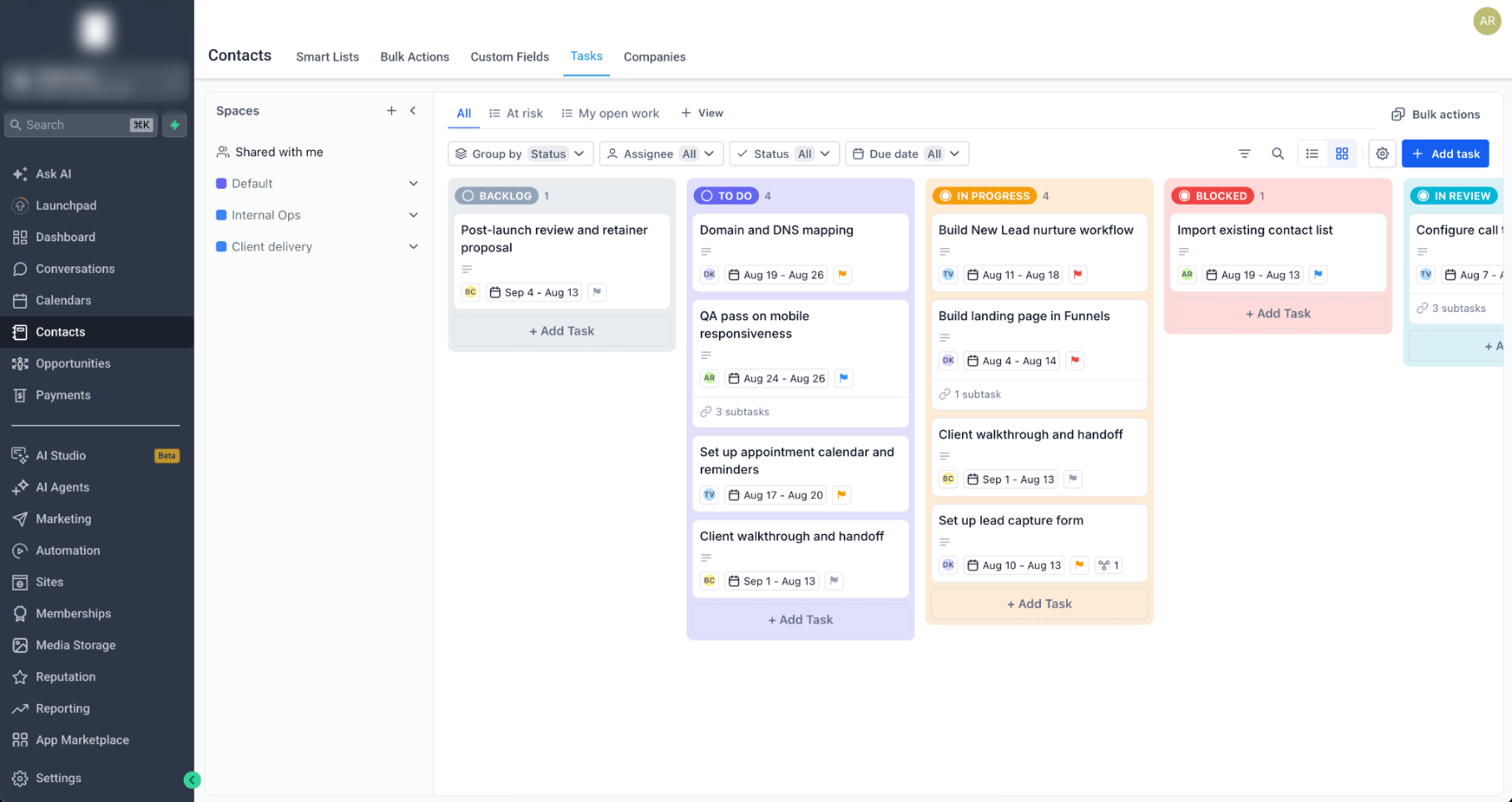
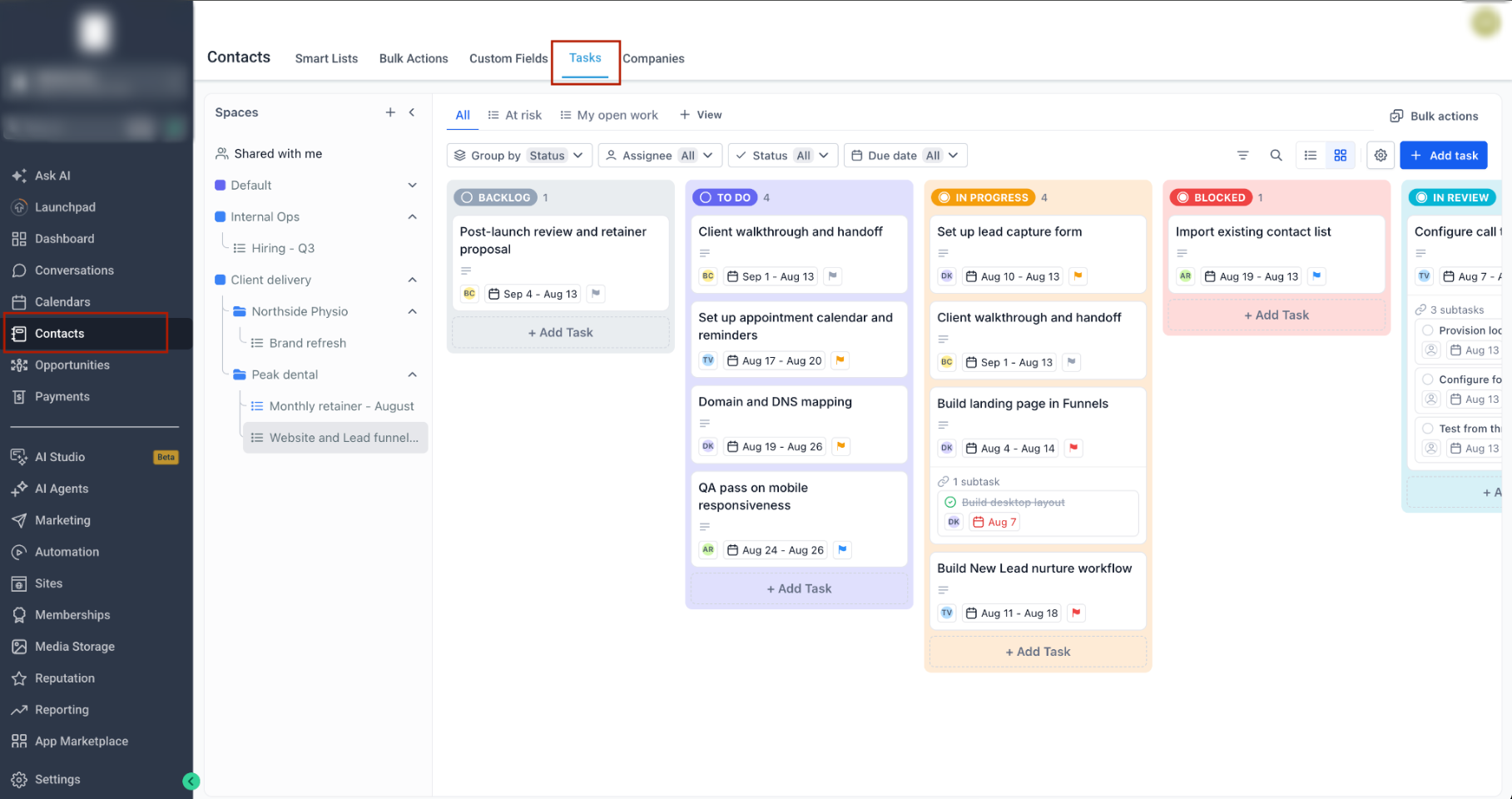
Project Management is available from the Tasks tab in the Contacts area. To open Project Management:
Select Contacts from the left navigation menu.
Select the Tasks tab at the top of the page.
Individual tasks have their own page address. When you open a task, the address includes a task identifier. You can copy the address from your browser and share it with another user who has access to that task.
Key Benefits of Using Project Management
One System of Record: Keep customer data and related work in the same platform without copying information between tools.
Clear Ownership: Assign tasks to team members and add dates and priorities so responsibilities remain clear.
Visibility at a Glance: Switch between Kanban and List views to see workflow stages or a detailed breakdown of your tasks.
Structure that Scales: Use Spaces, Folders, Lists, tasks, and subtasks to manage anything from a short checklist to a larger project.
Fields that Fit Your Process: Add custom fields to a Space so tasks capture the information your team needs.
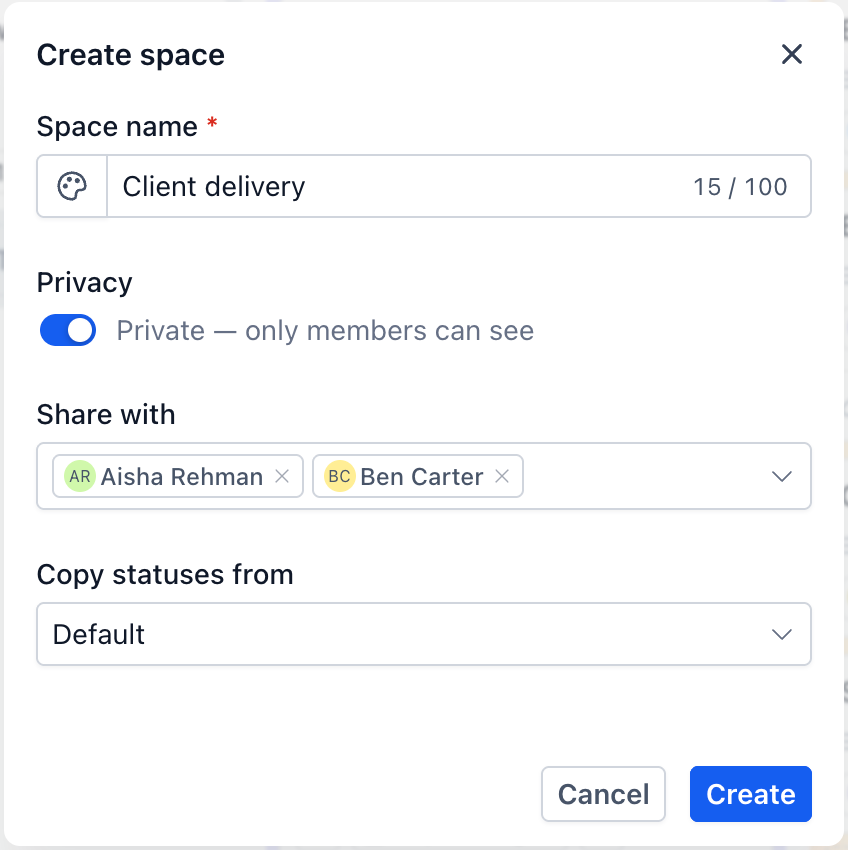
Controlled Access: Make a Space private and share it with selected members when work should only be visible to specific users.
Use cases for Project Management
Project Management can support many types of work, including:
Customer Onboarding: Create a repeatable onboarding checklist with assigned tasks and dates.
Campaign Delivery: Track creative, copy, and launch tasks for a marketing campaign on one board.
Internal Operations: Manage recruiting, finance, administrative, or other internal work in a private Space.
Service Delivery: Break larger pieces of work into subtasks and track progress stage by stage.
Sales Follow Up: Turn commitments made during a sales process into dated tasks so follow-up does not depend on memory.
How Work is Organized
Project Management uses a nested structure displayed as an expandable tree in the panel on the left side of the page.
Spaces
A Space is the outermost container. It usually represents a team, department, or major area of work, such as Marketing, Delivery, or Internal Operations. Each Space appears with a color indicator and can be expanded to show its contents. A Space contains its own:
Task statuses
Custom fields
Member list
Spaces can also be made private.
Folders
A Folder is an optional grouping layer inside a Space. Use Folders when a Space contains enough Lists that additional organization is helpful. A Folder contains Lists and can be expanded within the navigation tree.
Lists
A List contains the tasks themselves and typically represents a project, customer, or ongoing workstream. For example, you might create Lists for:
Q3 Website Refresh
Customer Onboarding
Monthly Marketing Campaign
A List can sit directly inside a Space or inside a Folder within that Space. Lists do not expand to display tasks in the navigation tree. Tasks appear in the main area of the page.
Tasks and Subtasks
A task is a unit of work inside a List. A subtask is a task nested under a parent task. Use subtasks to divide a larger piece of work into smaller steps.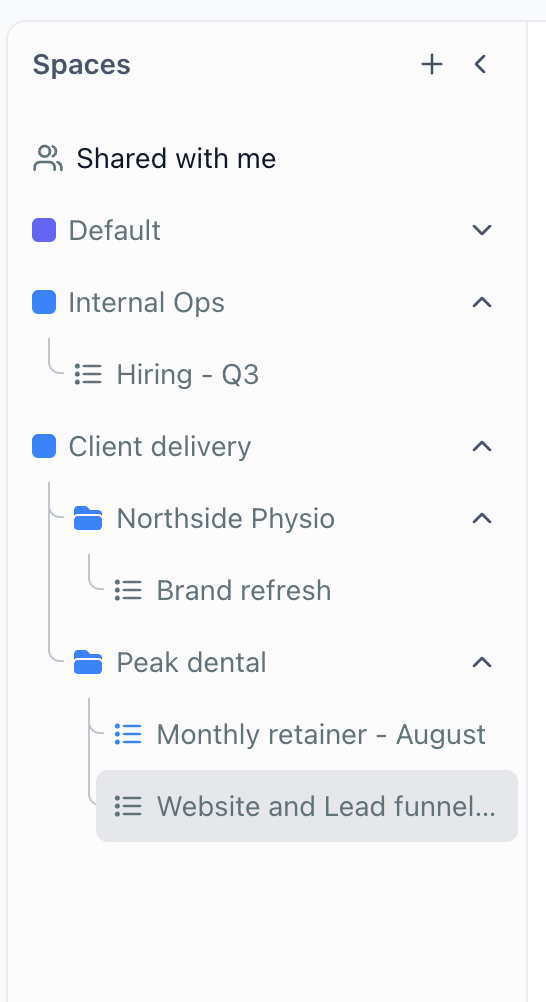
What a Task Contains
When you open a task, a panel slides in from the right. At the top of the panel, a breadcrumb shows where the task is located using the format Space / List. The task panel includes:
Task name: Edit the task name directly from the panel.
Description: Add details using the rich text editor, including formatting, undo, and redo controls.
Status: Shows the task's current stage. Available statuses come from the Space containing the task.
Assignee: Shows the person responsible for the task.
Dates: Add a single date or a date range. Dates display with the applicable time zone.
Priority: Set the task to Low, Normal, High, or Urgent.
All fields: View and complete the custom fields configured for the Space.
Associated objects: Link CRM records to the task.
Subtasks: View existing subtasks or add another subtask.
Comments: Add discussion or updates directly to the task.
Views: Kanban and List
The same tasks can be displayed in two layouts. Changing the view does not change the underlying tasks. It only changes how they are displayed, so you can switch between views as needed.
Kanban View
Use Kanban view to quickly see where work is in your process and identify tasks that may be stalled. Tasks appear as cards arranged in columns. Each column represents a status.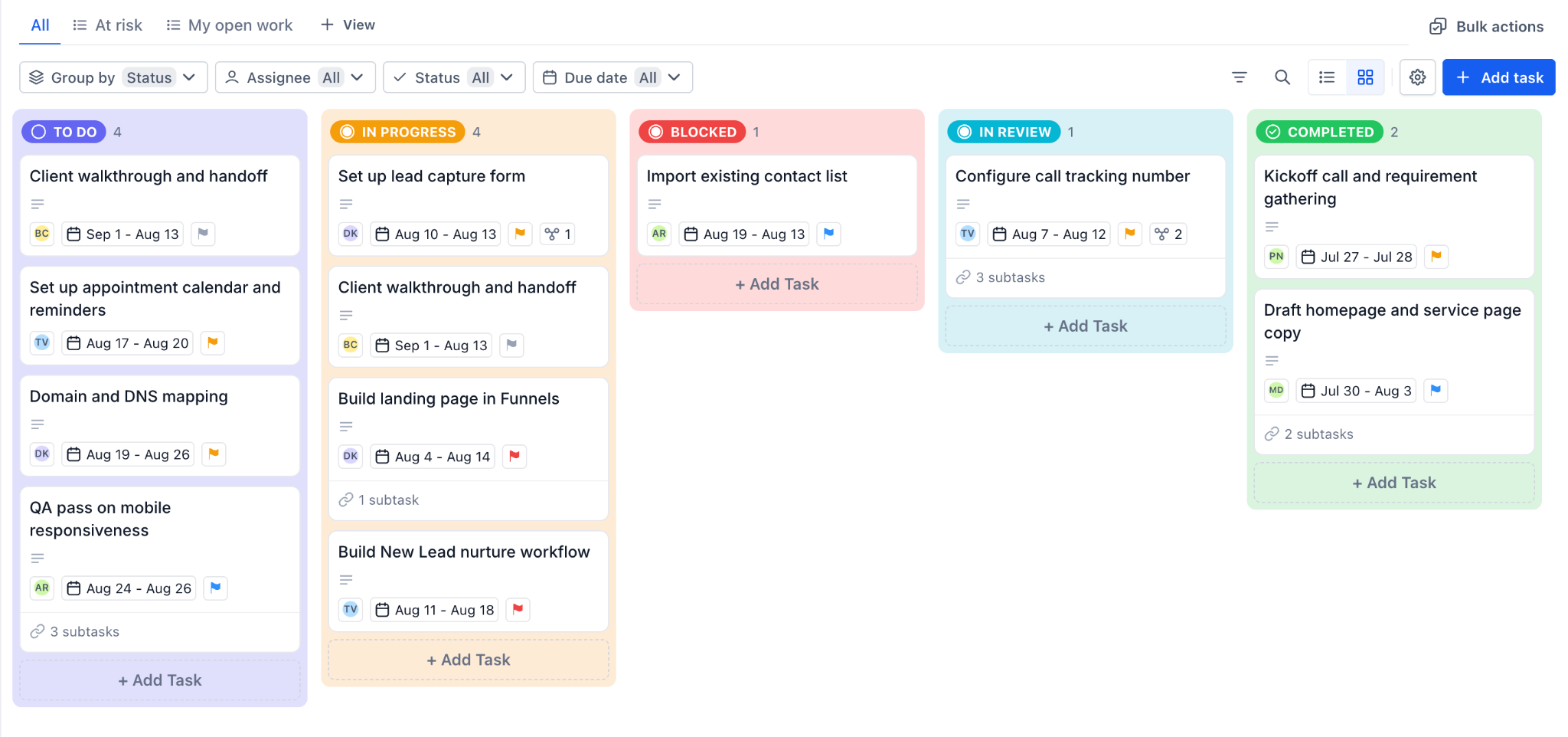
Column headers show:
The status name
The number of tasks in that status
Each column also includes an Add Task control. Task cards can display information such as:
Task name
Date or date range
Subtask count
List View
Use List view to scan multiple tasks and compare their details. Tasks appear as rows instead of cards. Use the View control in the toolbar above the board to switch between Kanban and List views.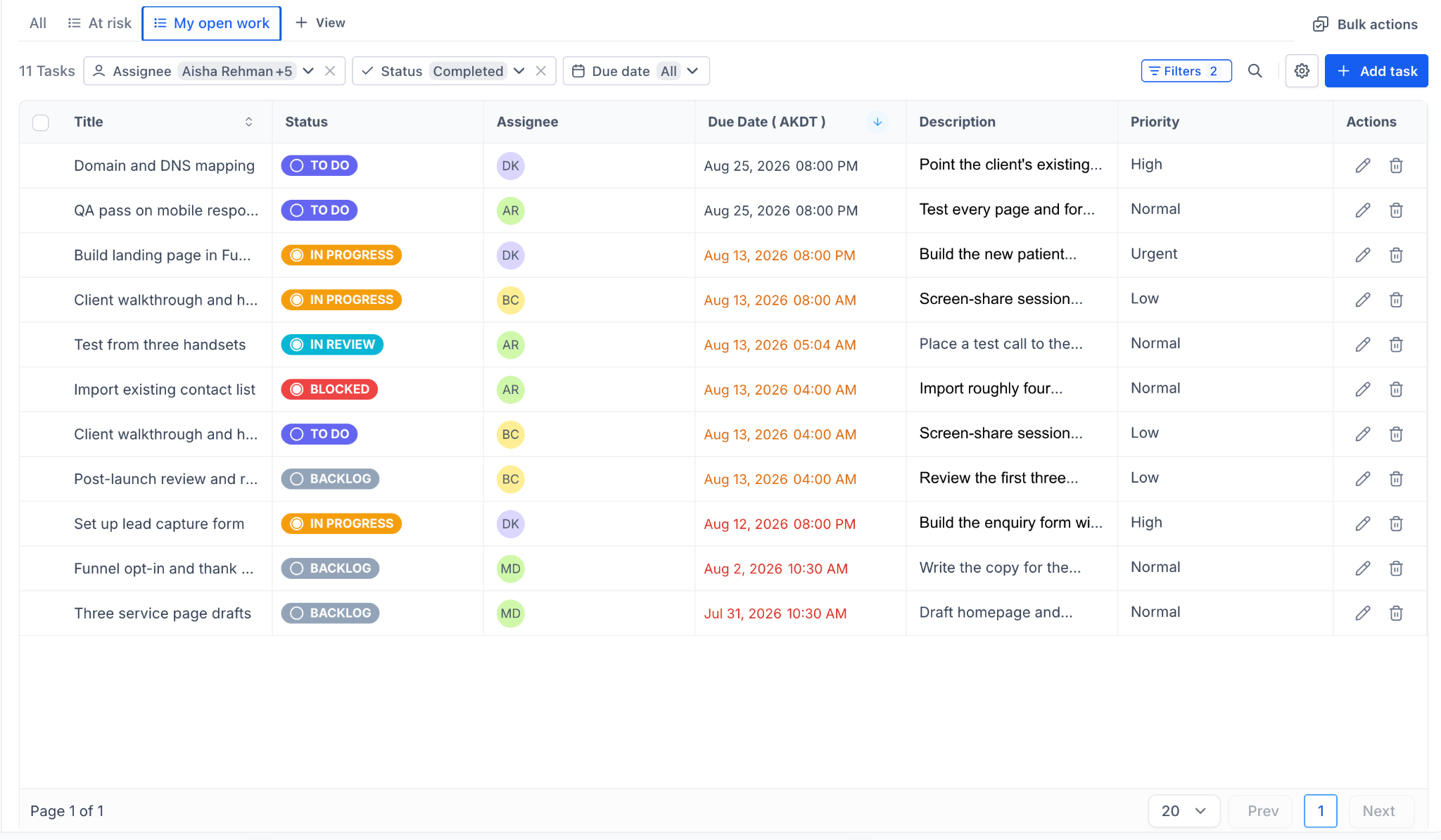
Steps for getting started
Open Tasks
Select Contacts from the left navigation menu.
Select the Tasks tab.
Create a Space
Create a Space for the team or area of work you want to manage. Choose a name that users can easily recognize, such as:
Marketing
Delivery
Internal Operations
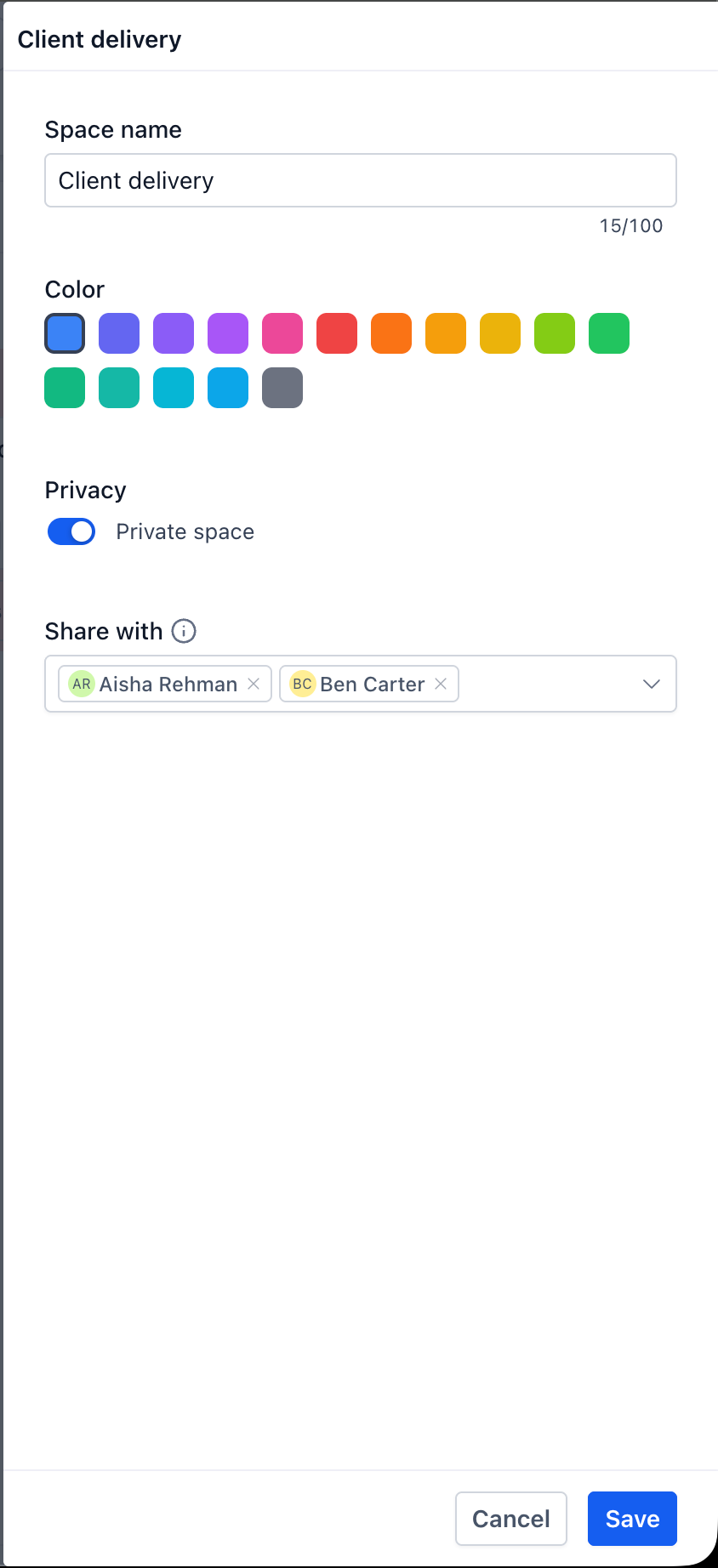
You can also assign a color to make the Space easier to identify in the navigation tree.
Create a List inside the Space
Hover over the new Space in the left panel.
Open the Space options menu.
Select Create list.
The List is where your tasks will live. If you expect to manage many Lists, select Create folder first and organize your Lists inside the Folder.
Review Your Task Statuses
Open the Space options menu.
Select Status options.
Each Space has statuses organized under three groups:
To Do
Doing
Done
You can add your own statuses to these groups. Review your statuses before adding tasks because they become the columns displayed on your Kanban board.
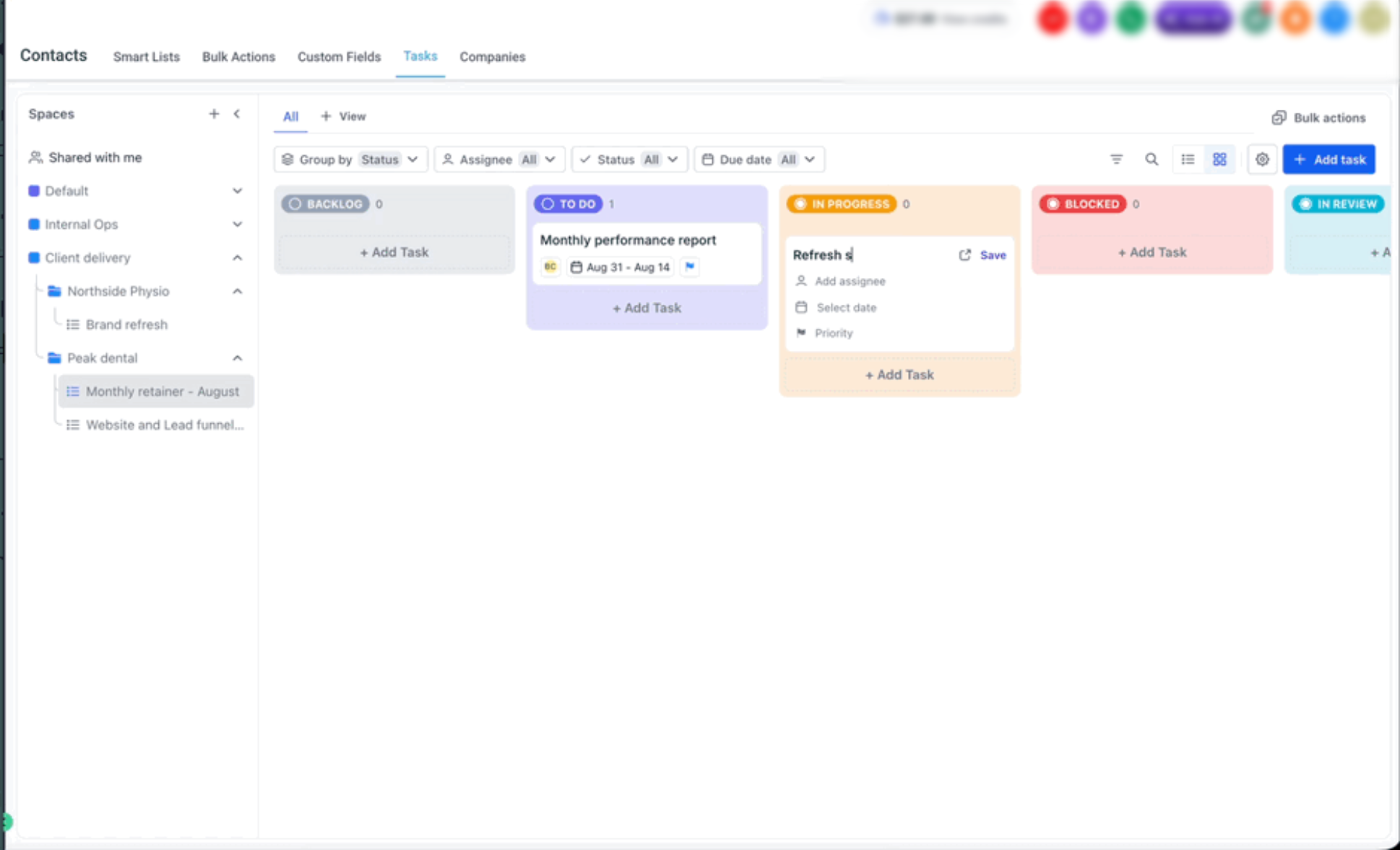
Create Your First Task
Select Add task from the toolbar, or select + Add Task at the bottom of the status column where you want the task to begin. Enter a clear task name, then set:
Assignee
Date
Priority
Add Task Details
Open the task to:
Add a description
Complete custom fields configured for the Space
Link related CRM records
Break Work Down with Subtasks
If a task contains multiple steps:
Open the task.
Find the Subtasks section.
Select Add Task.
This keeps the parent task as the main item while organizing individual steps underneath it.
Start working the board
As work progresses, drag task cards between status columns. Use Group by and the available filters in the toolbar to narrow the tasks displayed on the board.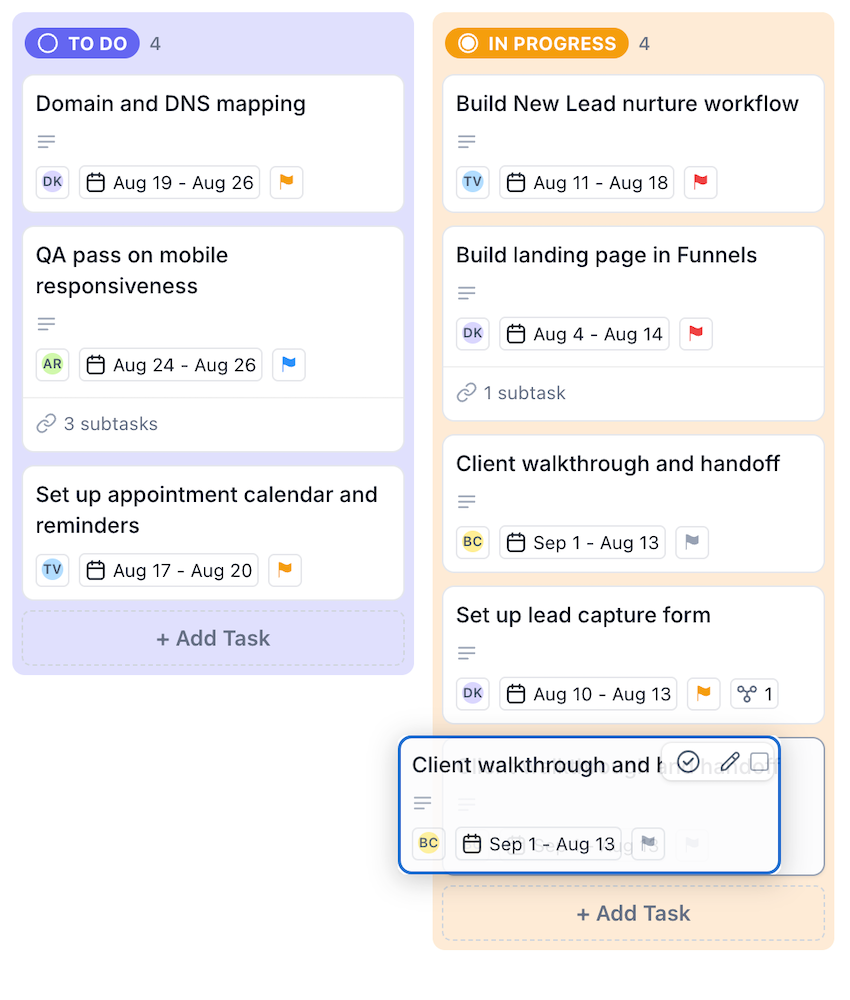
Control who can see the Space
After setting up your structure:
Open the Space options menu.
Select Settings.
Make the Space private if needed.
Choose the members who should have access.
Frequently Asked Questions
Q. Where do I find Project Management?
A. Open Contacts from the left navigation menu, then select the Tasks tab.
Q. What is the difference between a task and a subtask?
A. A task is a unit of work inside a List. A subtask is a smaller unit of work nested under a parent task. You manage subtasks from the Subtasks section of the parent task.
Q. Can I hide a project from the rest of my team?
A. Yes. You can make a Space private and share it only with selected members.
Q. Can I link a task to a contact or an opportunity?
A. Yes. Use the Associated objects section of a task to link related CRM records.
A. Yes. Open the task and copy the address from your browser. The address includes the task identifier, so the link opens directly to that task for users who have access.
Q. What happens to the tasks in a List if I delete the List?
A. Deleting a List also deletes the tasks contained in that List. Deleted items can be restored within two months using the applicable audit logs.
Q: What is the minimum I need, to create a task?
A name and due date. Assignee and priority can all be added later, though setting an assignee early is a good habit.
Need Help?
If Project Management is not behaving as expected, first review the Space, List, task settings, and user access.
Verify that:
- You are working in the correct Space and List.
- The task was created in the intended List.
- The task has the correct status, assignee, date, and priority.
- The Space contains the statuses you expect to see on the Kanban board.
- Custom fields have been added to the correct Space.
- The task is linked to the correct contact, opportunity, or other associated record.
- Subtasks were added under the intended parent task.
- The correct view is selected when switching between Kanban and List.
- Filters or Group by settings are not hiding the tasks you expect to see.
- The Space is not private unless restricted access is intended.
- The affected user is included in the Space member list when the Space is private.
- The user has access to any task link being shared.
- A deleted List or task has not been removed unintentionally.
If tasks appear to be missing, clear any active filters, confirm the correct Space and List are selected, and review whether the item was deleted or moved to another status.
If the issue continues, collect the Space name, List name, affected task name, user access details, expected behavior, and screenshots of the board or task settings before contacting support.