
WhatsApp user permissions let admins control which WhatsApp configuration actions each user can perform. Use these permissions to give users access to the WhatsApp tools they need while restricting sensitive actions such as deleting templates, managing phone numbers, or disconnecting the integration.
TABLE OF CONTENTS
- What Are WhatsApp User Permissions?
- Available WhatsApp Permissions
- How WhatsApp Permissions Work
- Set Up WhatsApp User Permissions
- Frequently Asked Questions
- Need Help?
What Are WhatsApp User Permissions?
WhatsApp user permissions are granular access controls that determine which WhatsApp configuration actions an individual user can perform.
They allow admins to restrict sensitive configuration changes without necessarily removing a user's broader access to WhatsApp.
Available WhatsApp Permissions
Seven individual WhatsApp permissions are available:
- Create/edit WhatsApp templates: Create new templates and make supported changes to existing templates.
- Delete WhatsApp templates: Delete templates where deletion is supported.
- Create/edit WhatsApp Flows: Create new Flows and make supported changes to existing Flows.
- Delete/deprecate WhatsApp Flows: Perform supported delete or deprecate actions on Flows.
- Update WhatsApp business profile: Update supported WhatsApp Business Profile information.
- Add/manage WhatsApp phone numbers: Add and manage supported phone numbers connected to WhatsApp.
- Disconnect WhatsApp integration: Disconnect the WhatsApp integration.
Note: Disconnecting the WhatsApp integration and canceling a WhatsApp subscription are separate actions.
How WhatsApp Permissions Work
The granular permissions apply to actions that change WhatsApp configuration, including creating, editing, deleting, managing, or disconnecting supported WhatsApp resources.
Read and preview behavior continues to use the broader WhatsApp access controls. Disabling a create or edit permission does not automatically remove all visibility into that resource.
Default Permission Behavior
Supported existing users retain their current WhatsApp management access by default. An admin can then disable individual permissions when a user should no longer perform a specific WhatsApp action.
What Happens When a Permission Is Disabled?
When a required WhatsApp permission is disabled:
- The corresponding action is unavailable in the Platform.
- The user may see contextual permission messaging for the restricted action.
- Supported direct API requests for unauthorized actions return a 403 Forbidden response.
For example, a user may still be able to open WhatsApp Templates but be unable to create or edit a template if Create/edit WhatsApp templates is disabled.
Set Up WhatsApp User Permissions
Configure WhatsApp permissions from the user's Roles & Permissions settings.
- Go to Settings → Users.
- Open the user you want to update.
- Open Roles & Permissions.
- Locate the WhatsApp permissions section.
- Enable or disable each permission based on the actions the user should be allowed to perform.
- Review the user's remaining module and granular permissions.
- Save the changes.
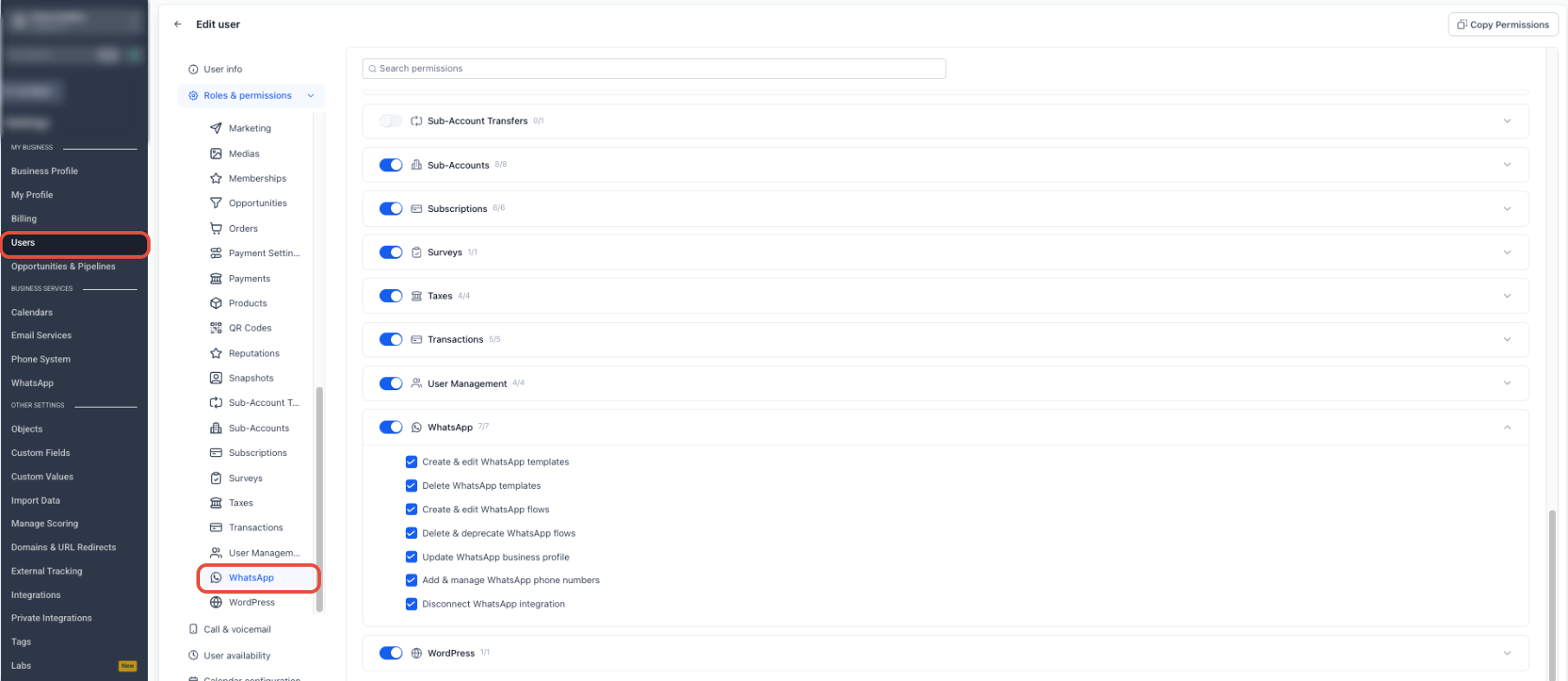
Tip: If a user suddenly cannot perform a specific WhatsApp configuration action, compare that action with the seven WhatsApp permission toggles before changing broader module access.
Frequently Asked Questions
Q: Why can a user open WhatsApp Settings but not create a template?
The user may have WhatsApp access but not the Create/edit WhatsApp templates permission. Review the user's Roles & Permissions settings and confirm that the required permission is enabled.
Q: Can I allow someone to edit templates without letting them delete templates?
Yes. Template creation/editing and template deletion use separate permissions, so the two actions can be controlled independently.
Q: Can I let a user create WhatsApp Flows without allowing them to delete or deprecate existing Flows?
Yes. Create/edit WhatsApp Flows and Delete/deprecate WhatsApp Flows are separate permissions.
Q: Does removing a create or edit permission prevent the user from viewing the resource?
Not necessarily. Granular permissions control supported configuration changes, while read and preview behavior continues to use broader WhatsApp access controls.
Q: What happens if an integration performs a WhatsApp action the user is not permitted to perform?
Supported unauthorized API mutation requests return a 403 Forbidden response.
Q: Does the Disconnect WhatsApp permission also allow a user to cancel the WhatsApp subscription?
No. Disconnecting the integration and canceling a subscription are separate actions. Follow the applicable subscription-cancellation process when canceling service.
Need Help?
If a user cannot perform a WhatsApp action:
- Go to Settings → Users and open the affected user.
- Review Roles & Permissions → WhatsApp.
- Confirm the permission that matches the action is enabled.
- Check broader WhatsApp access if the user cannot view the resource at all.
- For API requests, confirm the request is being made with a user that has the required permission.
If the issue continues, capture the affected user, WhatsApp action, current permission settings, and any error message before contacting support.